
Is the AI Boom a Bubble—Or the Beginning of a New Industrial Era?
AI has become the loudest conversation in tech. Generative models write content in seconds, LLMs automate workflows end-to-end, and AI-native platforms are reshaping how enterprises operate. But with rapid adoption and soaring valuations, a critical question continues to surface:
Are we experiencing sustainable innovation—or an AI bubble waiting to burst?
What the “AI Bubble” Conversation Really Means
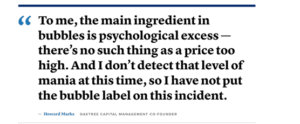
The term “AI bubble” echoes familiar patterns from the dot-com and crypto eras—markets where valuations soared faster than real adoption. Companies captured investment because of potential, not performance, and many collapsed when expectations met reality.
Today the AI landscape shows similar tension: massive optimism on one side, cautious skepticism on the other. The question isn’t whether AI is transformative—it’s whether expectations are accelerating faster than execution.
Why AI Hype Is Building So Fast
Breakthrough Innovation at Record Pace
Generative AI, LLMs, autonomous agents, and advanced automation are unlocking capabilities previously considered science fiction. Enterprise workflows—from engineering to operations—are being rebuilt around these models.
A Surge of Capital
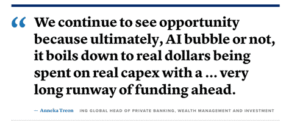
Corporations and venture firms are investing billions into models, cloud compute, and AI infrastructure. Funding records continue to break, signaling high confidence in AI’s long-term economic impact.
Media Momentum
Demos go viral. Headlines shape public perception. Social platforms amplify every advancement. This creates a powerful flywheel where awareness drives investment, which drives innovation—and more hype.
These forces together have accelerated the narrative of an AI “supercycle.”
AI Valuations: Ambition vs. Reality
AI companies are achieving valuations in the tens or hundreds of billions—often ahead of profitability. Startups raise on aggressive projections, sometimes emphasizing theoretical TAM (total addressable market) over proven revenue.
Leading examples include:
| Company | Approx. Valuation |
|---|---|
| OpenAI | ~$500B |
| Anthropic | ~$180B+ |
| Databricks | ~$100B+ |
| xAI | ~$70–80B+ |
These valuations reflect immense confidence but also fuel debate about speculation versus sustainability.
Why the AI Market Isn’t Just a Bubble
Despite the noise, AI is demonstrating unmistakable staying power.
Enterprise adoption is accelerating
Manufacturing, healthcare, finance, logistics, and energy are integrating AI into core operations—generating measurable efficiency gains.
Real ROI is emerging
Automation reduces labor costs, predictive analytics improves uptime, and intelligent workflows increase throughput.
Infrastructure is maturing
Advances in GPUs, cloud compute, model orchestration, and edge AI are creating a foundation capable of supporting large-scale enterprise deployment.
These trends point to an ecosystem with real economic value—not just speculative momentum.
What Could Trigger an AI Market Correction?
Even with strong fundamentals, certain market forces could slow momentum:
1. Overpromising Capabilities
Inflated expectations can create disillusionment when solutions fall short, resulting in slower adoption and reduced investment appetite.
2. Regulatory Friction
Privacy requirements, AI safety rules, and governance frameworks could delay product launches or increase compliance costs.
3. Funding Contractions
Economic pressures or investor fatigue could hit early-stage AI startups hardest, especially those without clear differentiators.
4. Market Saturation
With thousands of AI tools launching yearly, only the platforms delivering clear value will survive the consolidation wave.
Understanding these risks helps organizations avoid adopting AI based on hype alone.
Lessons from Past Tech Bubbles
The dot-com crash and the crypto winter share a common lesson:
Technology without real-world value doesn’t survive.
Companies that delivered tangible impact—Amazon, Google, and others—emerged stronger than ever.
AI now sits at a similar crossroads: sustained success will depend on solving real problems, not chasing trends.
A Responsible Path Forward for Enterprises
To move beyond hype and into meaningful transformation, organizations should:
✔ Focus on practical, high-impact use cases
Prioritize initiatives with quantifiable business outcomes.
✔ Pilot, measure, iterate
Validate value before scaling investments.
✔ Work with proven AI partners
Select vendors who build solutions around outcomes—not just algorithms.
✔ Build internal AI literacy & governance
Empower teams to understand capabilities, limitations, and ethics.
This balanced approach ensures AI initiatives drive measurable value instead of becoming speculative bets.
Bottom Line
The AI market is experiencing unprecedented momentum—but not all of it is speculative. With clear ROI, expanding infrastructure, and deepening enterprise adoption, AI’s long-term trajectory remains strong. The key is navigating the hype responsibly.
AI delivers real business transformation when grounded in strategy, governed with discipline, and implemented with purpose.